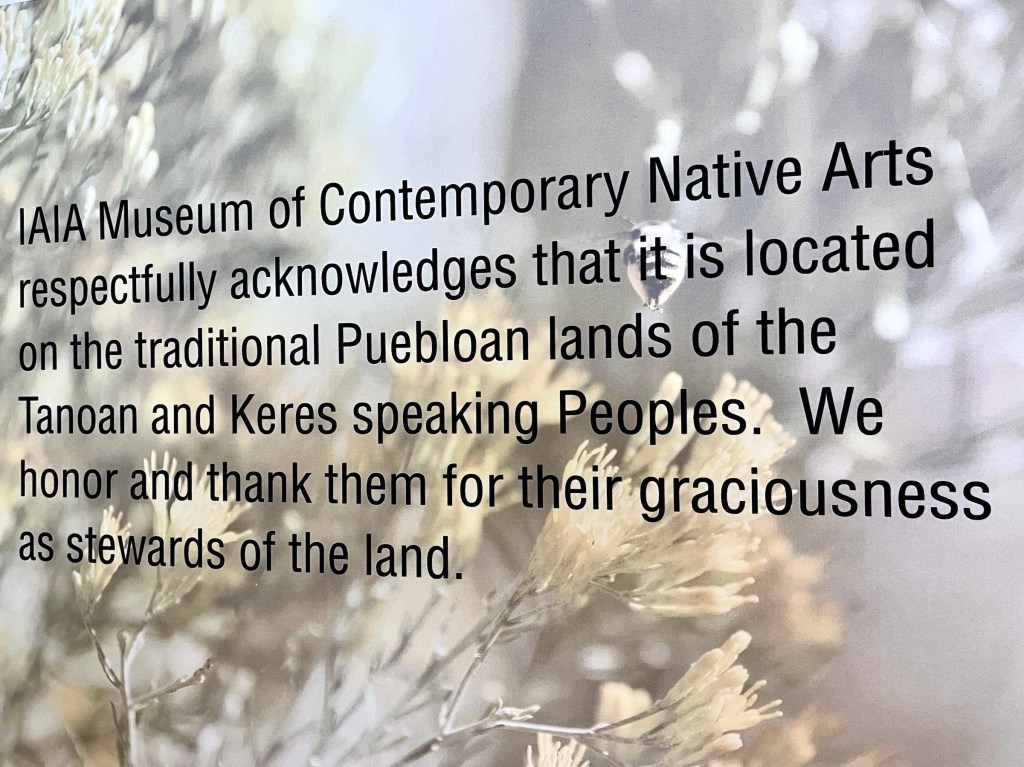
Northern New Mexico with its well-known towns of Santa Fé, Taos, and Los Alamos, is really a patchwork territory of Pueblo Indian Reservations. Our vacation place is in the San Ildefonso Reservation, our supermarket is in the Pojoaque Pueblo, Po’su wae geh the water gathering place, while next door to it, in the Tesuque Pueblo, one finds the Camel Rock Studios where any number of major movies were filmed. Five more pueblos join the aforementioned ones, namely Taos, Picurís, Ohkay Owingeh, Santa Clara, and Nambé, to form the Eight Northern Pueblos. I shall report more details in due time. For now, let’s just remember that before Spanish and US colonialism altered the human condition in the Southwest, all of this land was populated by Pueblo Indians. Around town, these facts are clearly recognized through plaques like the ones we saw in the museums:

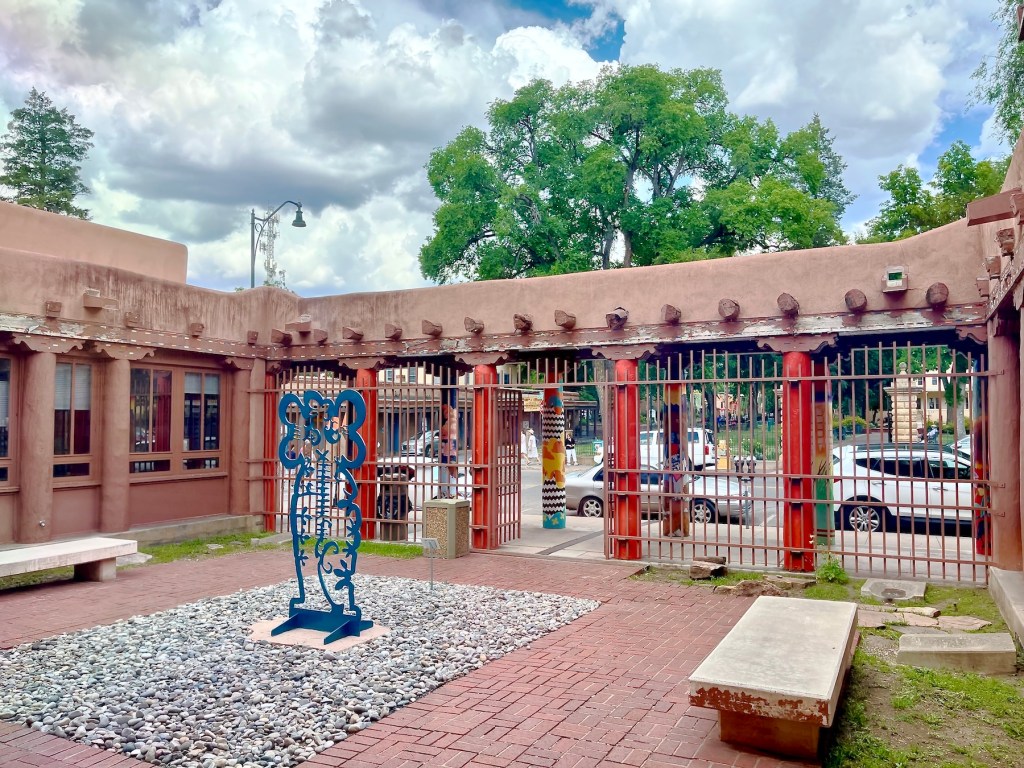
Our destination was the IAIA Museum of Contemporary Native Arts, located in the heart of historic Santa Fé, where it presents itself most cheerfully to the public.
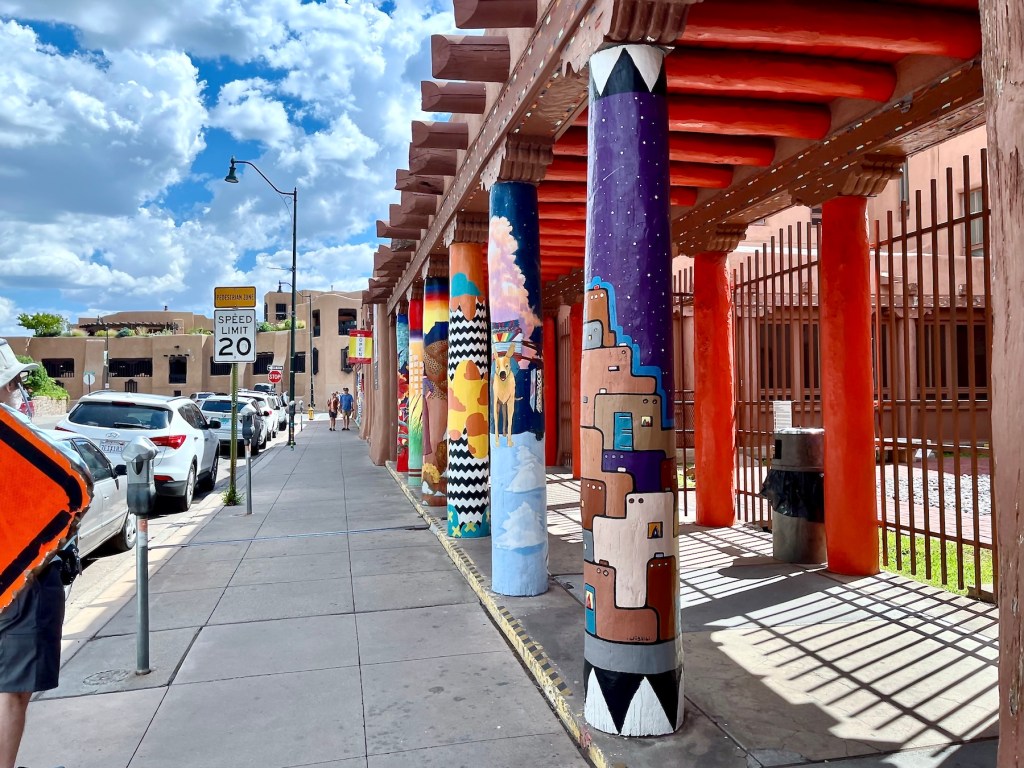

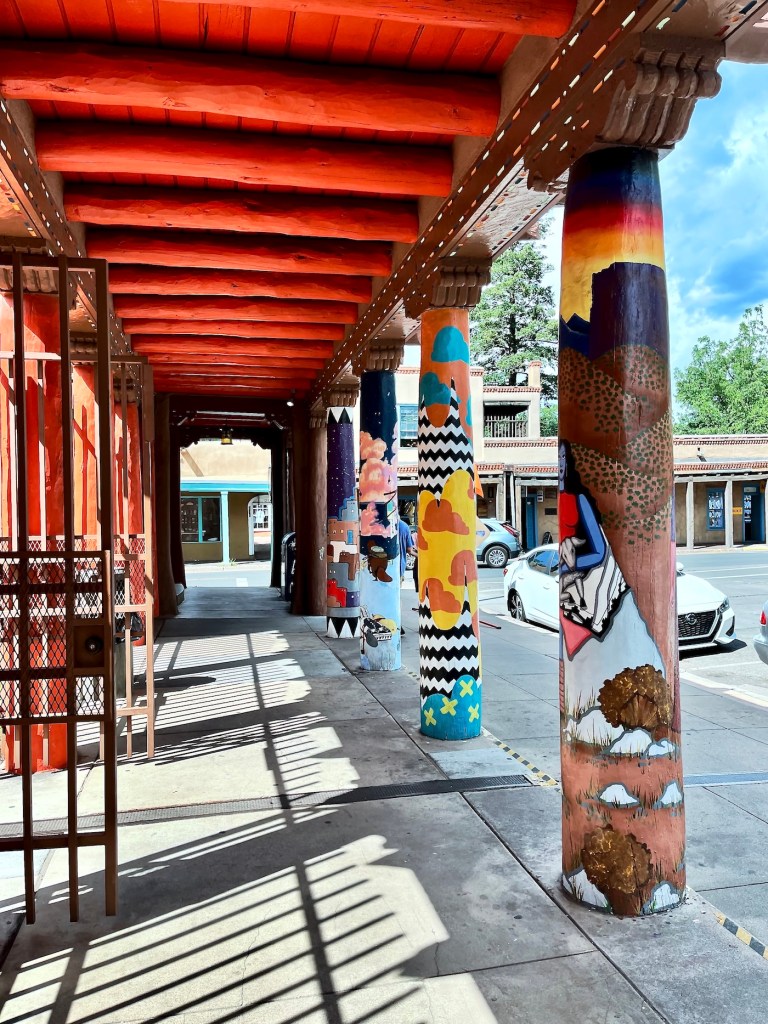


Even before entering, we came across a painting that reminded me of my own Friedensreich Hundertwasser painting, a good beginning!


There was also a poem posted near the entrance:
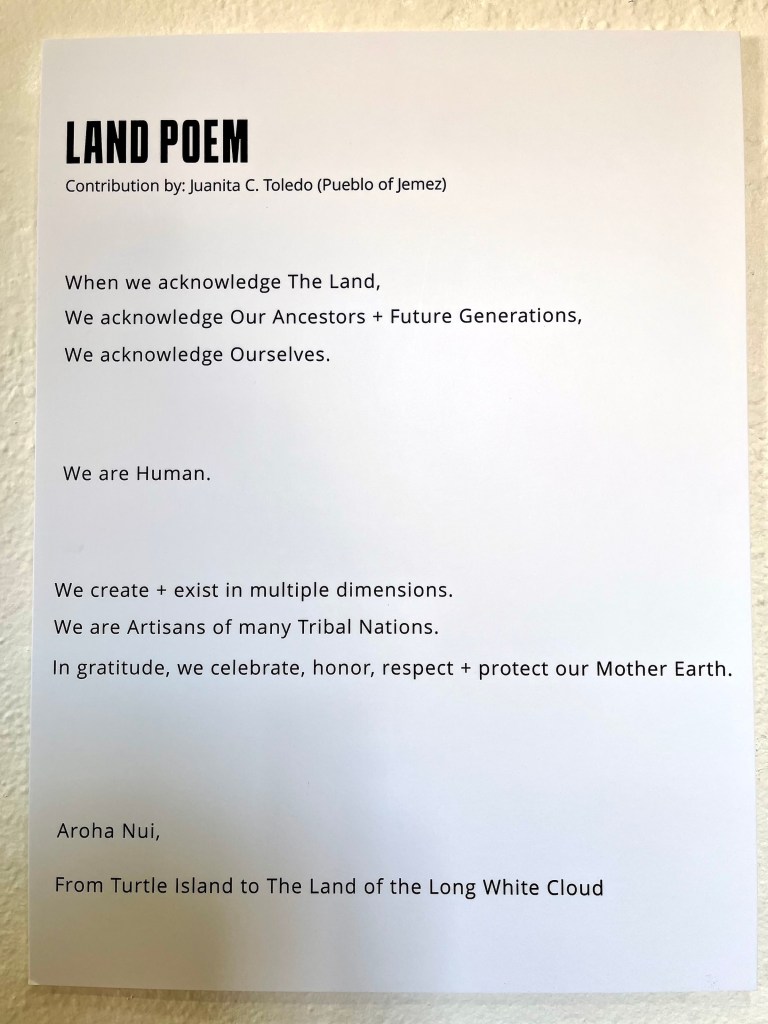
[Aroha Nui = ‘much love’ in Māori; Turtle Island = North America, sometimes even the world; Long White Cloud = New Zealand, specifically the Northern Island]
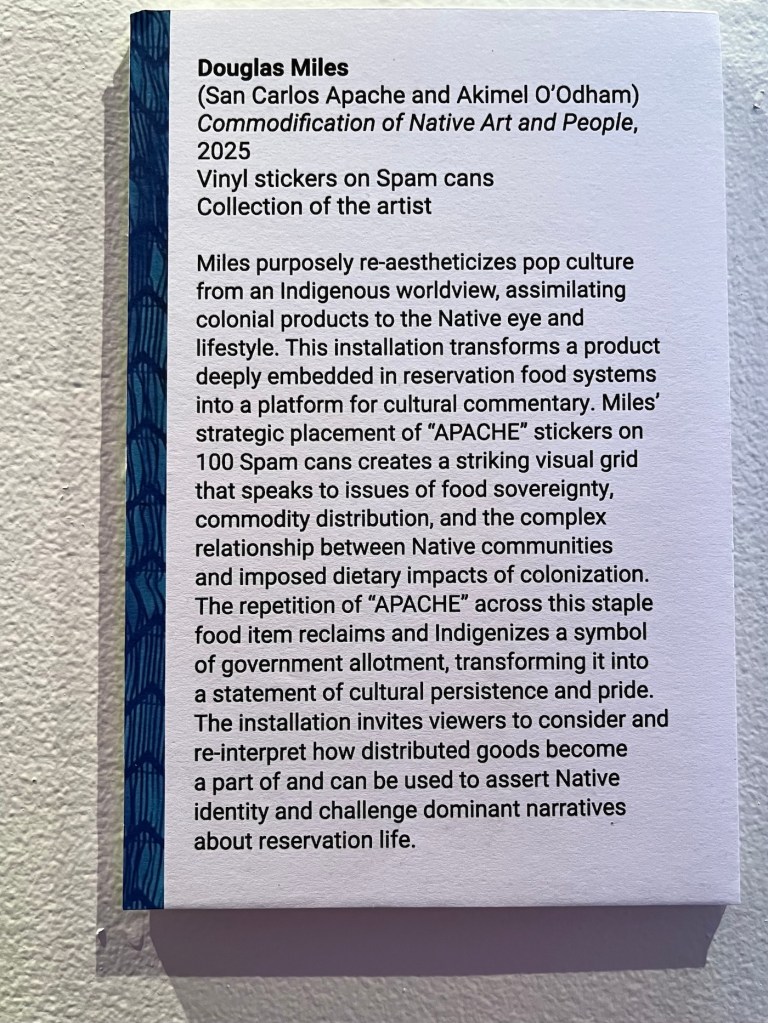
The first gallery we saw was dedicated to Douglas Miles, street artist, activist, and leader-of-indigenous-youth, who was the museum’s Artist-in-Residence earlier in 2025. His company, Apache Skateboards, resonates deeply with reservation kids.



Back in the lobby, a large panel explained the work of Dr. Suzanne Kite. However, a brief afternoon visit is not sufficient for even a rudimentary understanding of her ideas, and the adjacent displays/work stations were equally incomprehensive on the fly. Above all, though, having displays set up on the floor is a problem for old people. We can’t easily read the instructions or explanations down there, and squatting down to shorten the acuity angle is just as impossible. Unfortunately, neither stools nor binoculars were provided, so we moved on rather hastily. Actually, I was most interested in the spelling of Oglála Lakȟóta in the panel, a Lakota spelling I had never seen before. The likely origin of the term Sioux, by the way, is also interesting, as it may have been a French plural ‘oux’ added to the native tribal name Nadowessi by the explorer Jean Nicolet, turning it into Nadouessioux. When I was a little girl growing up in Germany, we pronounced Sioux See-oox. Never mind, you had to have been there …

One floor up, we found The Stories We Carry exhibition with so many pieces, details, and surprises, it was mindboggling, educational, and at times very entertaining. I’m happy to show you a few of the artworks that caught my eye, either because of their beauty or workmanship, or because they made me smile.


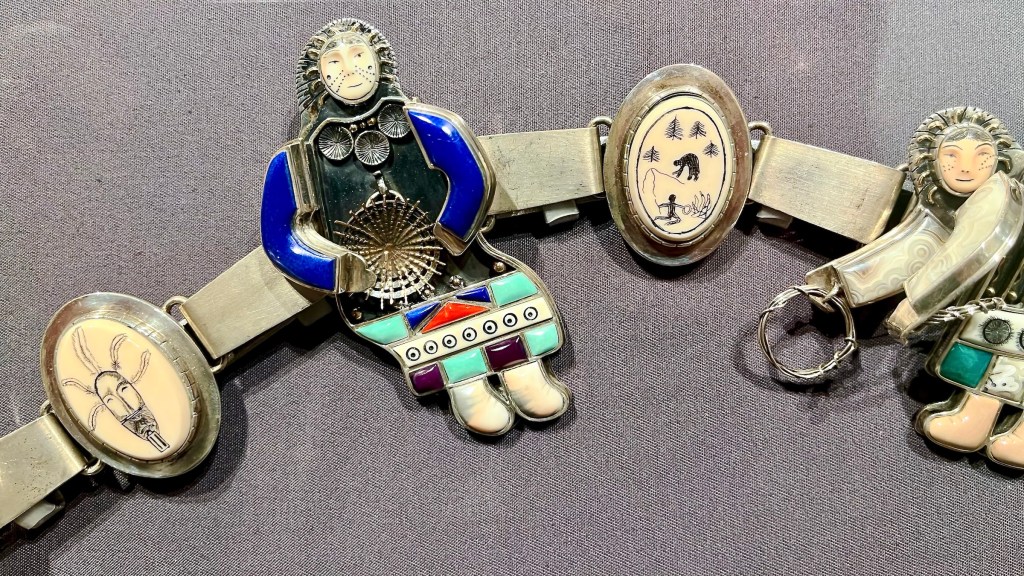
Denise Wallace, I loved the details in her work!


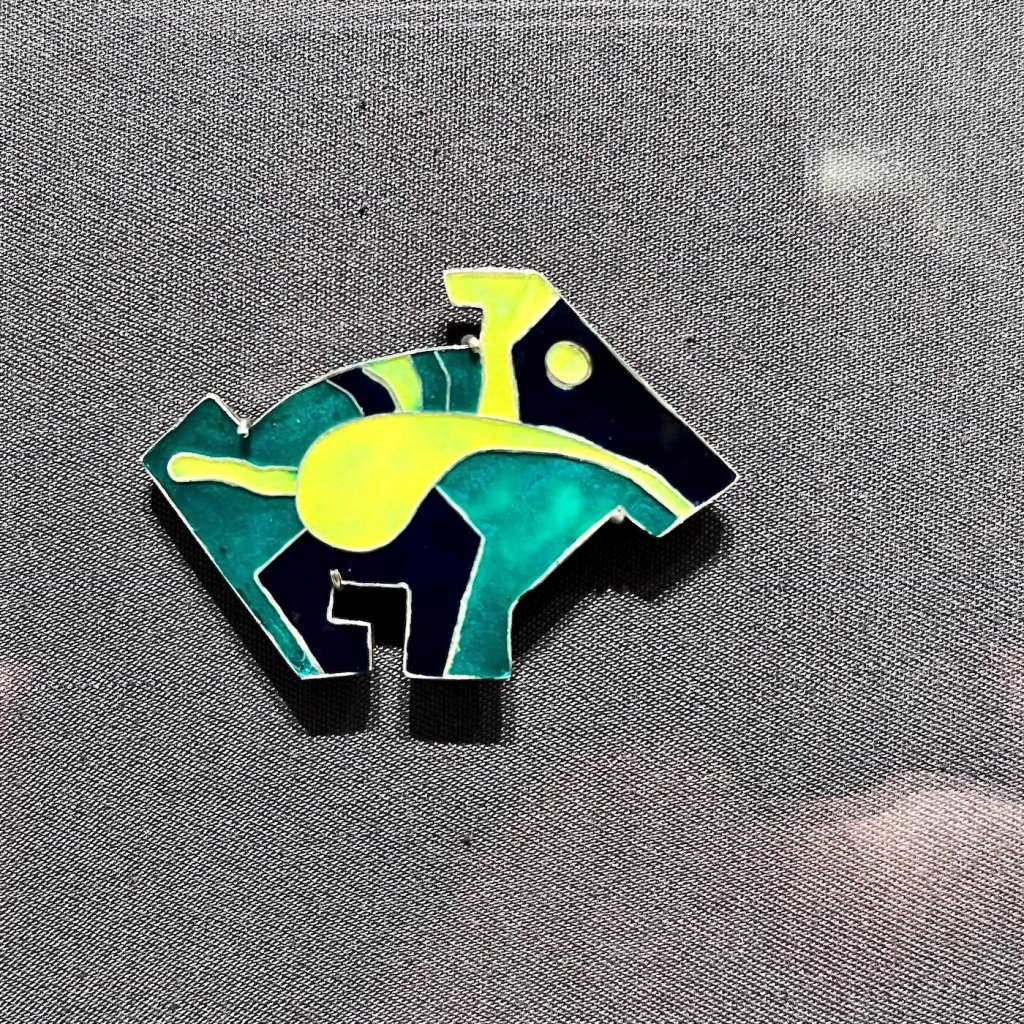


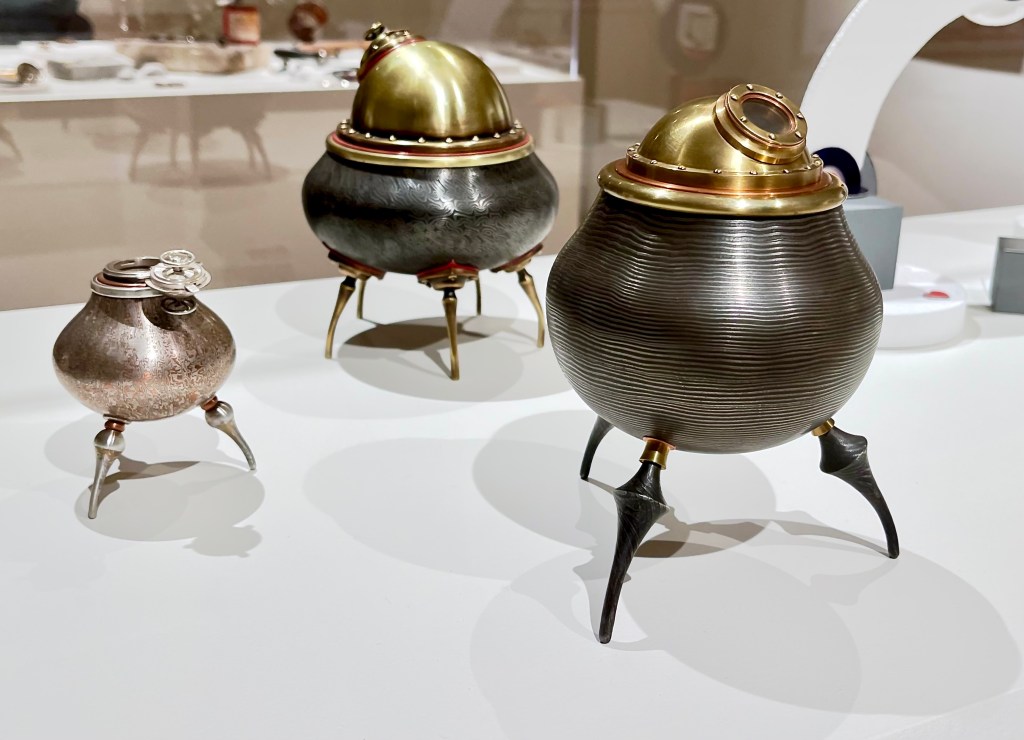
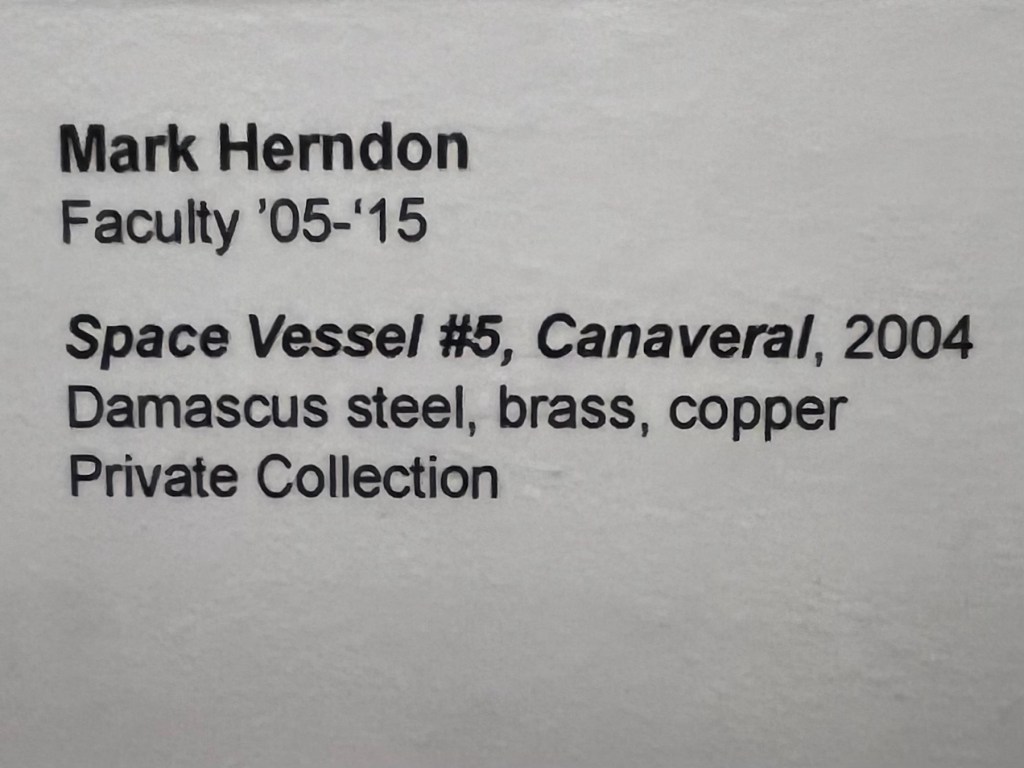
In another fully enclosed display case, I came across these funky space ships, or alien diving bells, maybe? They were beautifully forged by former faculty member Mark Herndon.


Below we have an Otter Amulet. A 1998 Isaac Tait quartz carving, suspended from several painted sweetgrass strings, and decorated with a raven feather. Tait was born from the Raven and Frog clans of the Nisga’a people in British Columbia, Canada.

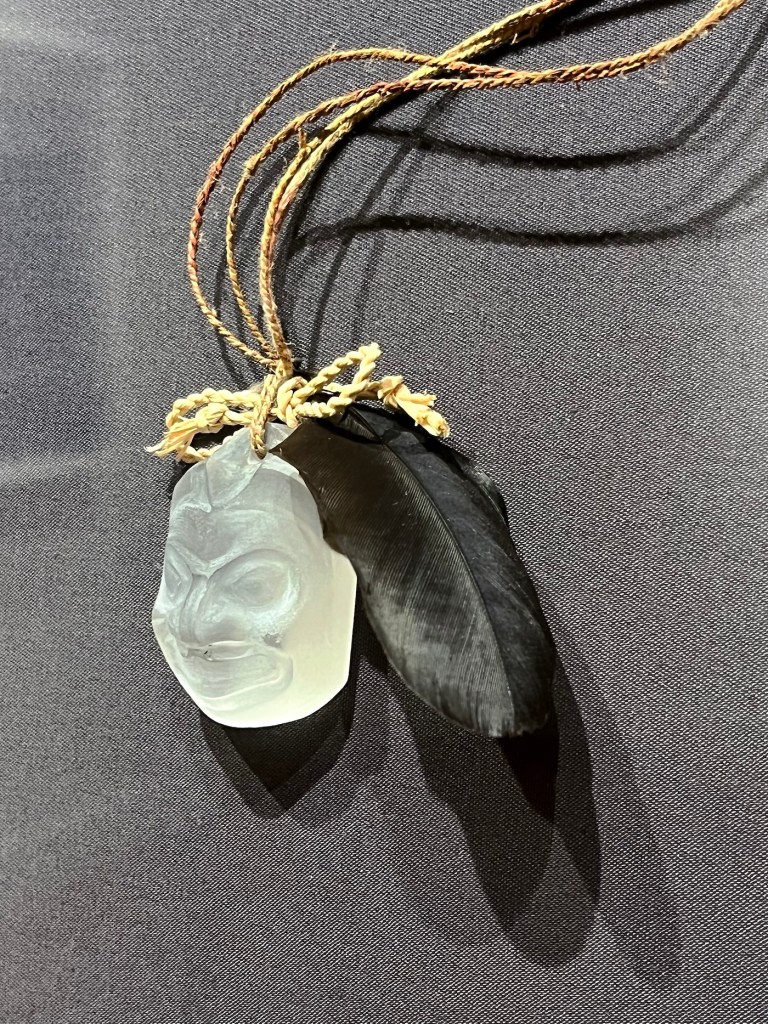
The delicate yet expressive carving tugged at my heartstrings. It saddened me to learn that Isaac Tait died so very young. The Gorman Museum of Native American Art in Davis, CA, displays a striking silkscreen print by Tait alongside a brief biography highlighting his remarkable achievements.
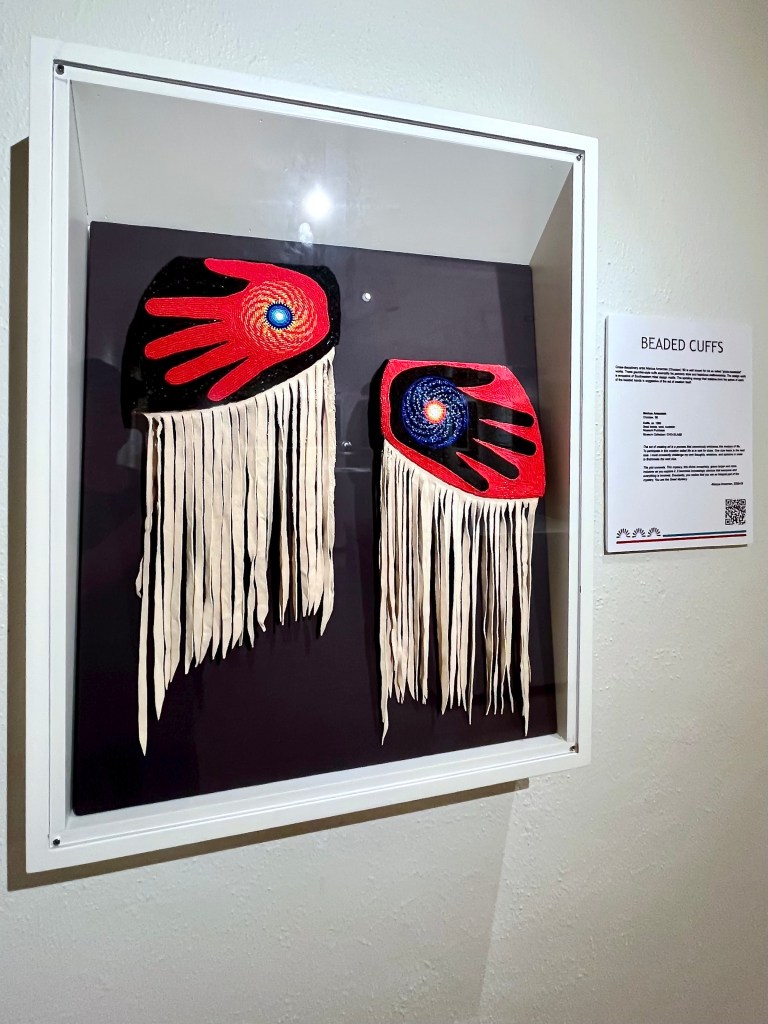
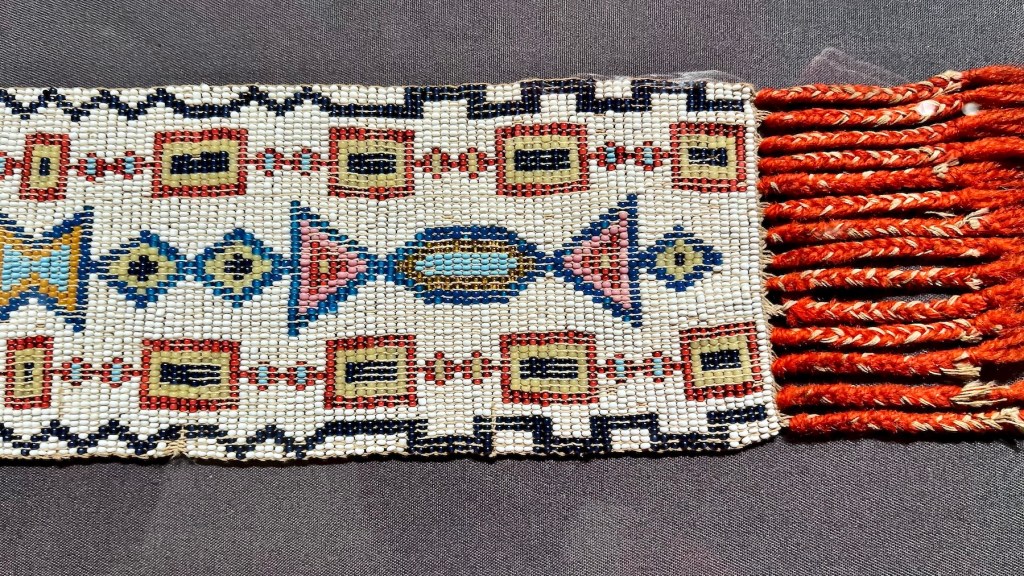
A fair section of the exhibition showed beadwork, a Native American tradition going back to prehistoric times. On powwows.com, you find an article titled Native American Beadwork | Traditional Beading History, Patterns & Styles. It’s detailed and informative, but I didn’t link it directly because the website is heavily littered with ads and who knows what else.
The following shows a few beadwork examples from the museum.



I detected a distinctly masculine presence in the Bow Guard display, not that I had any idea such things even existed. Ramos Pacheco, of Kewa/Santo Domingo Pueblo, crafted his stylish bow guard in 1969 of silver, turquoise, and leather, whilst Navajo artisan Mark Holiday borrowed the imagery for his 2001 bow guard from Nordic Inuit culture. And why not, right? They’re all Athabaskan, after all. Notice how each one of the tiny silver buttons on Holiday’s guard wears a unique facial expression and sports a different hairstyle!


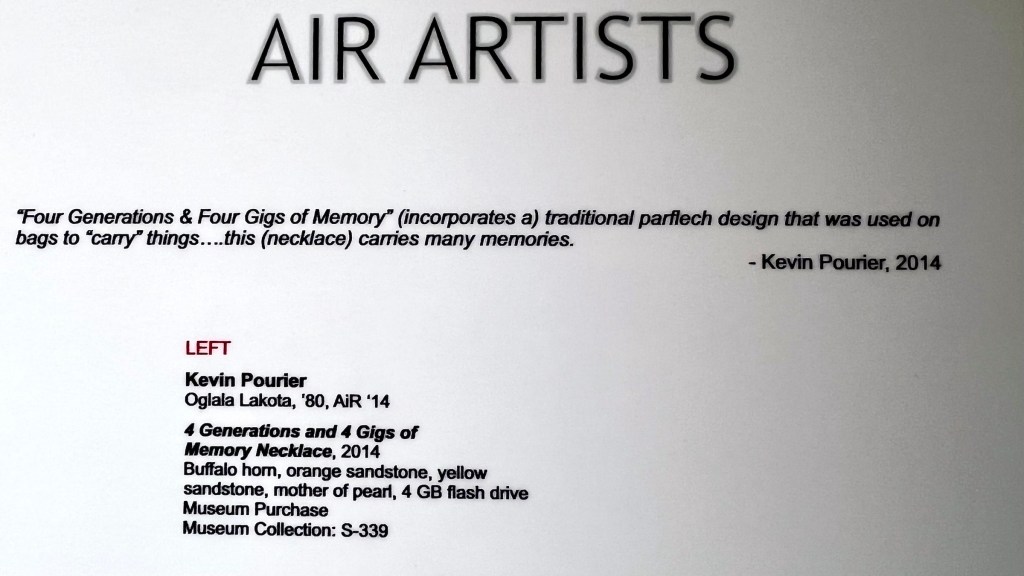
If we follow the arc from traditional crafting to contemporary expression, we have to appreciate one more inspired, but also funny, design, a necklace by Kevin Pourier, a Lakota Sioux, and as such a member of the Oglala Sioux Tribe of the Pine Ridge Reservation, South Dakota. Kevin and his wife, Valery Pourier, also Oglala Lakota, collaborate in creating their highly regarded buffalo horn spoons and jewelry.

In 2018, the Pouriers won Best of Show at the famous Indian Market in Santa Fé, NM, with their work called Winyan Wánakikśin, which means Women Defenders of Others. It is an extraordinary belt made of buffalo horn conchae portraying eight Native women leaders. It now lives in the Potomac Atrium of the National Museum of the American Indian in Washington, D.C. Do check it out through the above link!
Now that we enjoyed such intense encounters with all of these tremendously talented and creative people, it’s time to mosey on home and relax with a cool drink. Lead the way, Mr. Beaver!

P.S. As a zoologist, I feel compelled to add a postscriptum regarding my, admittedly nitpicking, Buffalo versus Bison stance.
A. There are no Buffalo in the Americas.
B. Buffalo, Syncerus caffer, Bovidae, with their five subspecies, are only found in Africa. The Cape Buffalo is the best-known representative.
C. In India and Southeast Asia, we find the Asian Buffalo, Bos Bubalis, Bovidae, with five species, including the wild and the domestic water buffalo.
D. Together, Syncerus and Bubalus represent the True Buffalo.
E. Bison, on the other hand, live on the North American continent. Bison bison, Bovidae, are divided into two subspecies: the huge wood or mountain bison, B. b. athabascae, and the more moderate B. b. bison, the bison that roamed the prairies of the Great Plains, both in the US and in Canada. The American bison is joined by its European relative, Bison bonasus, Bovidae, the Wisent, which is the heaviest wild land animal in Europe.
F. Calling the American bison ‘buffalo’ may go back to early 17th-century French explorer Samuel de Champlain, who based it on ‘buffles’, wild ox. Blame the Frenchies, again!!
P.P.S. The so-called ‘buffalo horns’ used for decorative purposes as described above are actually the keratinous horn caps, not the bony horns themselves, which are living tissue.

 NOT IN A STRAIGHT LINE by Photolera Claudinha
Long Live the See-ooks
Dr. Barry N. Leon
707 Cardinal Lane, #A1 Austin, TX 78704
USA
On Sat, Jul 26, 2025 at 4:37 PM NOT IN A STRAIGHT LINE by Photolera
LikeLike