AT SEA, MAY 1, 2023
All together, we sailed for a little over 30 hours to reach the Albanian coast, moving from the Aegean Sea into the Ionian Sea just as night lightened into day.
For some reason, I awoke around then and stepped out on our balcony to take some pictures of this grey, overcast May Day morning with low hanging clouds nearly obscuring nearby coastal features.
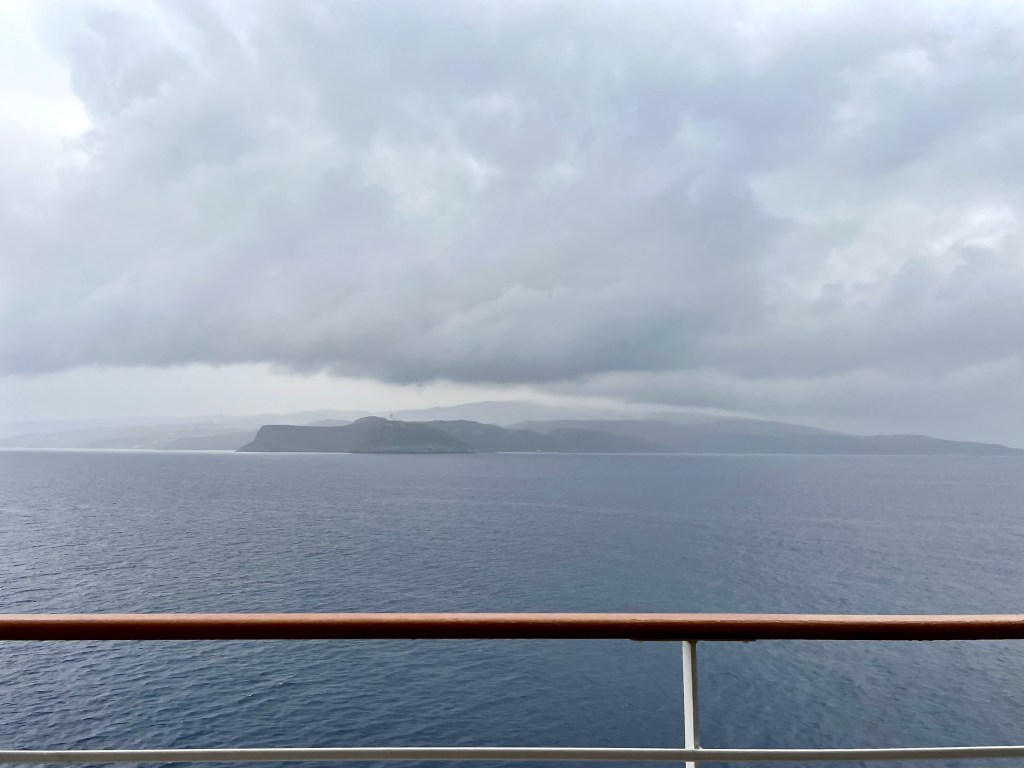
When I noticed a blinking lighthouse, I zoomed in and tried to depress my shutter in time to catch the flashing light.

Back inside our cabin, pouring over my pictures, google maps, and local landmarks, I eventually realised that I may have, possibly, accidentally, captured the lighthouse of Ακρωτήριο Ταίναρο, Akrotirio Tainaro, Cape Tainaro, also called Cape Matapan, the southern most point of the Balkans, and one of the most southern points of continental Europe. Since ancient times, however, this barren outpost has had yet another name, the Gate of Hades. The entrance to the Underworld, guarded by the beast Cerberus. If you’d like to read about this fascinating spot in more detail, I suggest to start here CAPE TAINARO.
A day at sea is a lovely, leisurely, lazy time to do nothing more than read and be pampered by your butler, or one could try new cocktail concoctions in the different bars. Alternatively, participation in a multitude of physical activities is always an option, or joining lectures and other cultural activities offered on the Silver Moon. One of our favorite activities most afternoons at 16:45 was ‘Team Trivia’ in the Dolce Vita Lounge with Cruise Director Roy Perez. Before we moved to France and met British expats, and also watched UK television, we had never even heard of trivia as a team sport. My goodness, are they competitive! And by now so are we!!
On sea days, unsurprisingly, there is a lot of water around and below the Silver Moon. Particularly when sailing WSW of the Peloponnese, where we passed over the Calypso Deep in the Hellenic trench, the deepest part of the Mediterranean Sea. The first crewed descent into the trench happened in 1965 in the French bathyscaphe Archimède. The second occurred quite recently, on February 10, 2020, when renowned contemporaneous explorer Victor Vescovo took Prince Albert II of Monaco down into the Calypso Deep, and back up again, confirming its depth of 5 109 m or 16 762 ft. There was indeed quite a bit of salty water beneath our keel!
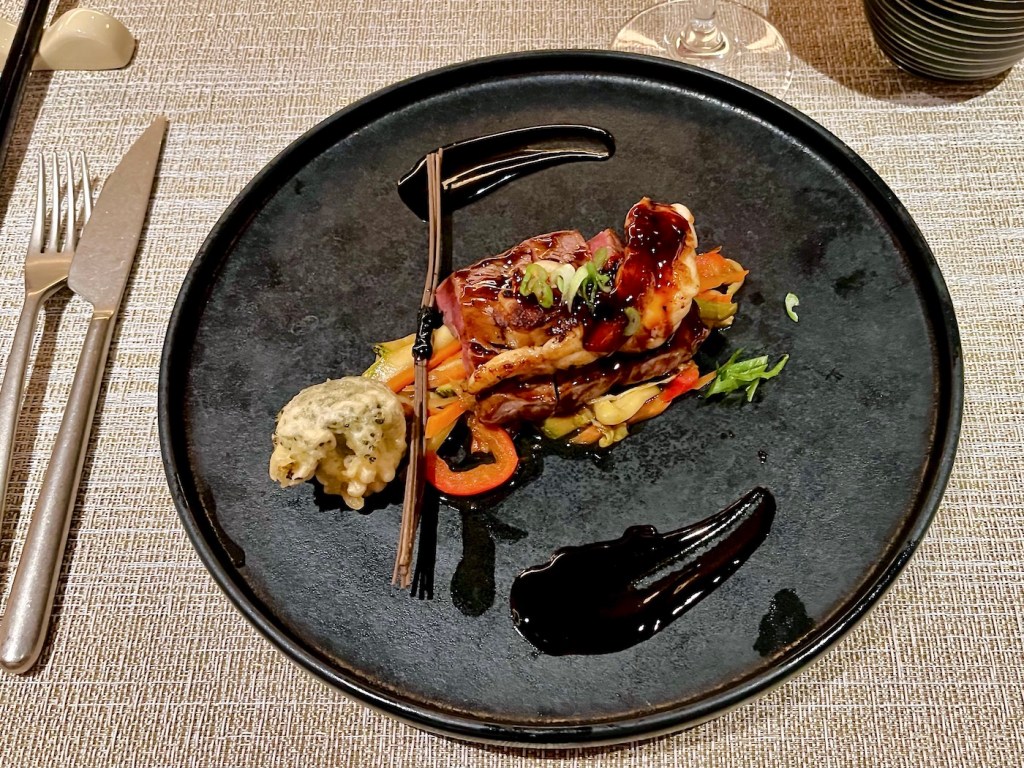
Our group of six friends repaired for dinner to the highly praised Kaiseki restaurant. Sadly, none of us was charmed. One lady in our group had lived in Japan for several years, while others had visited multiple times. All of us felt that the menu choices didn’t seem to follow Kaiseki rules as we understand them. The dishes were presented in western proportions, and styles, they looked messy, and one was dominated by soy sauce saltiness.


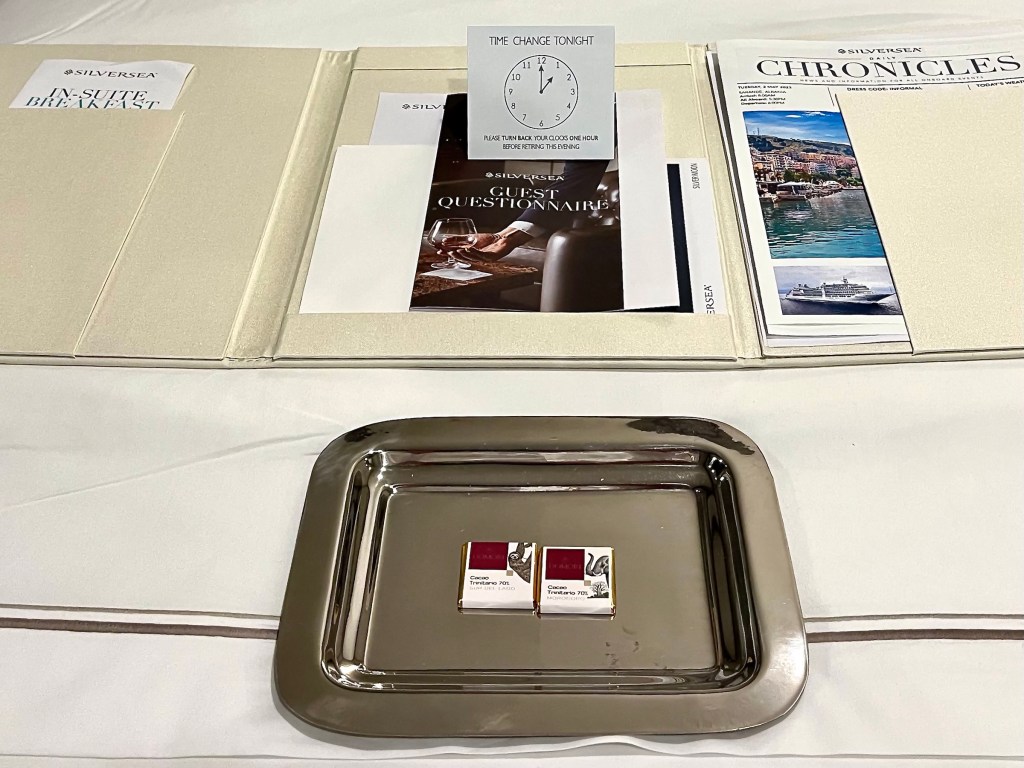
Since we were leaving the Greek timezone during the night, our butler reminded us to set our clocks back by one hour before bed.
SARANDË, ALBANIA, MAY 2, 2023
The Balkan Peninsula has been settled since the Bronze Age. Time and again, powerful countries, and power-hungry dictators tried their luck in the Adriatic coastal region that the Greeks called Illyris and the Romans Illyria. Greek Generals, Imperial Rome, the Ostrogoth, the Ottoman Empire, the Republic of Venice, Hungaro-Habsburg, Italy, with & without Mussolini, Tito’s Federal Republic of Yugoslavia, Stalin, Mao, and lastly Slobodan Milošević, they all nibbled on Albania. But in the end, the Albanian’s worst enemy turned out to be one of their own, Enver Halil Hoxha, who managed to shutter his country so completely that by 1978 Albania had neither an ally nor a trading partner in this world. And despite a significant improvement in health care, literacy, and women’s rights Albania was the poorest country in Europe by a fair margin. After the fall of the communist rule, horrifyingly bad advice by the IMF resulted in the implementation of a pyramid scheme, yes, a gigantic pyramid scheme, that crushed the country’s already weak economy. It bankrupted the Albanian government and two-thirds of its people in 1992. That started extensive civil unrest, which promoted the rise of brutal gang warfare, centring around human trafficking and arms dealing. If that wasn’t bad enough, the Kosovo War followed 1998-99.
The Balkans have always seen trouble and hardship. In ancient Rome, even before the heyday of its imperial period, the Senate used Illyria to teach manners to young hot-shots from ruling houses. Gaius Julius, Gaius Pompeius, Gaius Octavius, and many others, they all learned strategy and cunning while pitching themselves in battle against Illyrian tribes. In our contemporary times, we still fight along the Balkan coastline, but now it appears, we mostly battle over condo developments and such. Yet, in Albania, and up and down the Dalmatian coast, history is ever present. Age-old sins perceived and crimes committed are neither forgotten nor forgiven by the different ethnic groups calling the Balkans home.
The Silver Moon docked in the resort town of Sarandë. There is a 20 min ferry connection from Sarandë to the Greek island of Corfu. Since ferries also commute frequently between Corfu and Southern Italy, the beaches of Sarandë Bay have become popular with Italian tourist. This is an eminently more positive Sarandë-Corfu link than existed during Hoxha’s days. Young men, mostly, swam secretly to Corfu to escape the oppression. Their heartbroken, silent mothers never knew if they had made it across safely because it was a crime to communicate with a traitor. The successful refugees couldn’t contact their families back home, owing to Sippenhaftung, the collective punishment of clan or family for a crime committed by one member.
The town name goes back to the Forty Martyrs of Sebaste, Άγιοι Σαράντα, Hagioi Saranda, forty Saints in Greek. As testified by Saint Basil the Great (330 – 379) Bishop of Caesarea, forty Christian members of the Legio XII Fulminata, a legion originally enlisted by Gaius Julius Caesar in 58 BCE for his Gallic wars, were martyred as a group in Sebaste, Sivas Province, Turkey, around the year 320 CE. The Forty Martyrs are venerated throughout the Faith, and became especially important in Eastern Orthodox denominations. A monastery and pilgrimage site was built during the 6th century and dedicated to the Forty Saints. Its name was later transferred to the nearby town of “Sarandë”.
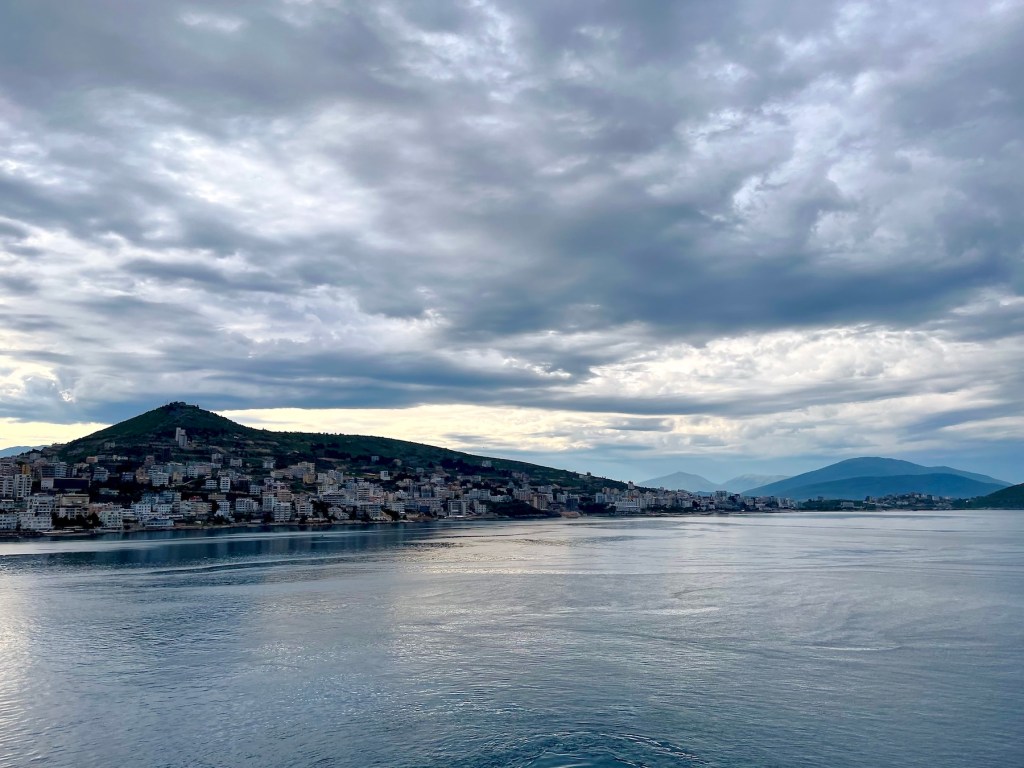
We had opted for an excursion to the Lëkurësi Castle high above the town for a folkloric performance, followed by a visit to a winery. Dance, drink, and far views over mountain ranges, what could be better?


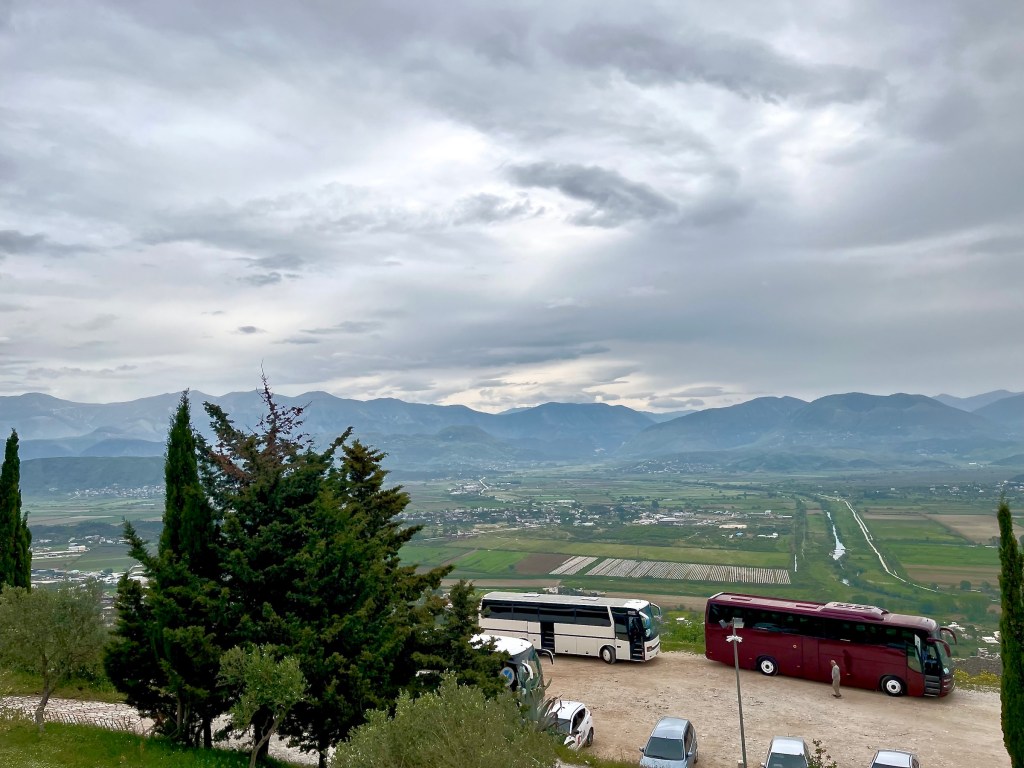


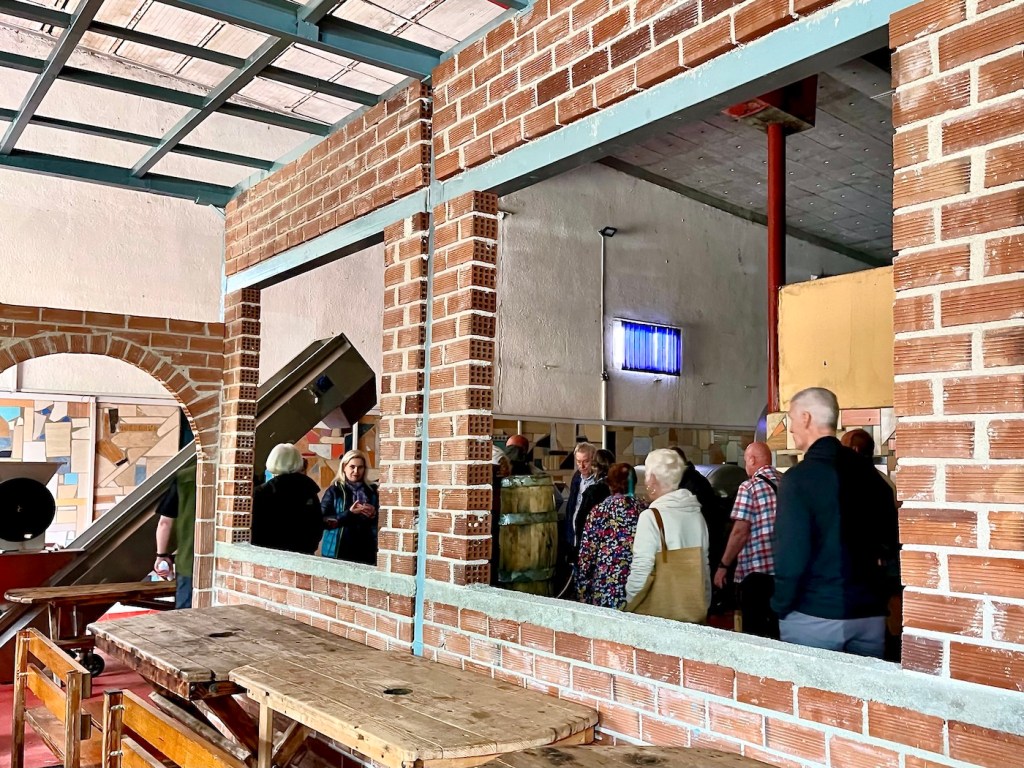
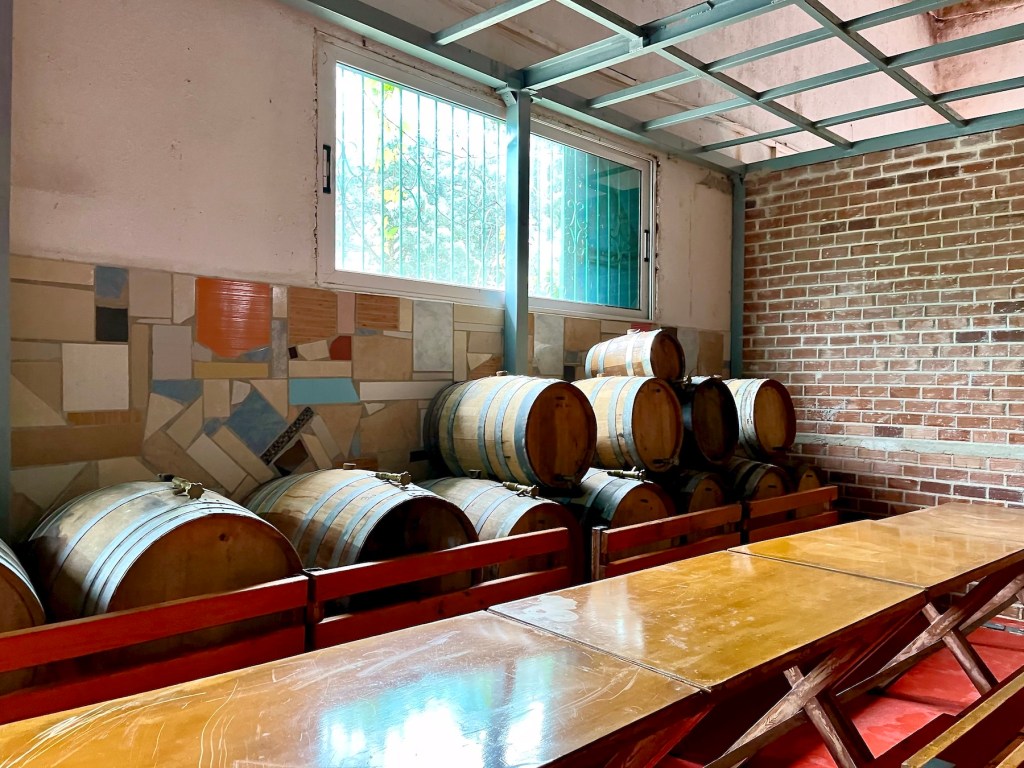


Our tour guide did a phenomenal job to point out buildings of note and special landmarks during our drive through Sarandë and its surrounding countryside. She was a fountain of knowledge regarding Albania’s history with special details about Hoxha’s iron fisted actions, and her countrymen’s painful climb into the 21st century. Our guide also translated for the vintner / farmer during our tour of the winery, vineyard, greenhouses, olive pressing shed, and tasting. Isak’s seemed to have been active for about 2 years, operating as a harvest cooperative for both wine and oil. All its shiny new equipment came from Italy. The farm also produces biologically grown fruit, greens, and root vegetables for sale in local markets, as well as for their own lines of preserves, chutneys, pickles, condiments, and honey. We got to sample a range of their products which were very tasty, fortunately, because their wines were pretty awful. Early days yet, of course.
We stayed only a scant ten hours in Albania. The early departure was necessary for the relatively longer nightly crossing to our next port of call, Bari in Italy.

 NOT IN A STRAIGHT LINE by Photolera Claudinha