Friends,
You may not have noticed, but it’s been over four months since I abruptly stopped publishing my travel posts. The reason for this silence was a significant deterioration of my idiopathic trochlear nerve palsy, which made the necessary research and even the actual writing impossible because I couldn’t focus properly.
I first introduced you to my quirky eyes fourteen years ago. Since that was such a goodly stretch of time ago, I thought it might be useful to repost the two most relevant entries below.
To set the scene, you must join me in traveling back to the year 2012, when my husband and I still lived on our ranch in Kerr County, TX, and I was still a green card-holding legal alien. Two years prior, we had bought a vacation home in Costa Rica, which nearly spelled my legal downfall as an alien. Hopping between our two residences, I was in danger of spending more time abroad than is permissible for foreigners, potentially forfeiting the benefits I had earned. Potentially even risking my legal status in the USA per se.
Hence, after 34 happy alien years, I finally submitted the paperwork for my naturalization application in January of 2012. In our boundless naïveté, we believed that my application would be approved in just a few weeks. Had I not been a law-abiding, employed taxpayer for over three decades? Sadly, we were very wrong.
Three months on, only my husband returned to Costa Rica, while I had to cancel my ticket. You see, during the naturalisation process, an applicant isn’t allowed to leave the country, ever, under any circumstances, no exceptions. I stayed alone on the ranch till October, and all that idiopathic eye stuff happened during my summer of solitude.
Terminology used:
DIPLOPIA, or double vision, is an ophthalmologic disorder in which the viewer perceives the image of a single object as two separate objects.
PALSY is a medical term referring to paralysis or paresis, weakness. It’s nearly always used in reference to a cerebral or facial disorder, as in external or internal ophthalmoplegia or ophthalmoparesis.
The TROCHLEAR NERVE, or 4th cranial nerve, is one of 12 paired nerves in the head that control sensation and movement. The trochlear nerve controls the actions of just one single eye muscle, the ->
SUPERIOR OBLIQUE MUSCLE or obliquus oculi superior. This tiny muscle facilitates the downward and inward motion of the human eyeball.
TROCHLEAR NERVE PALSY is the paralysis of the 4th cranial nerve. In consequence, the motor function (movement) of the superior oblique muscle of the eye is incapacitated. That means my little palsy qualifies as an external ophthalmoplegia. Don’t we just feel ever so much better when our afflictions have a fancy name?
The trochlear nerve is the longest of the paired cranial nerves controlling eye movement, and it is usually the nerve that may be damaged in an accident with head trauma. If even one of the six muscles attached to an eyeball doesn’t work properly, the eyes can’t move synchronously, as they must for proper visual input.
When you look at an object, and the movement of both eyeballs is perfectly identical, each eye transmits an image of this object to a matching cluster of neurons in the bilateral brain via electrical impulses. In other words, the visual input from both eyes stimulates a matching locus in the visual cortex of the brain. But, and this is the lynchpin here, if a dead muscle fails to rotate an eyeball in sync with its twin, the visual cortex receives electrical impulses in two separate places. For your brain, you appear to be looking at two objects when there is really only one. My double vision manifests as vertical diplopia, meaning I perceive the object my brain conjures below and slightly to the right of the real one. Additional factors, like bright or flashing lights or rapid movements around me, can turn my vision into nightmarish kaleidoscopic scenarios.
The FUSION AMPLITUDE is an ophthalmic measurement. When the eyes transmit visual input to loci that are too far apart to be reconciled into a single image, the distance between these two images, one true, one false, is called the fusional amplitude. I don’t remember my initial amplitude measurement when I was first diagnosed in 2012; it might have been four. During the ten years we lived in France, it climbed from seven to nine, and after cataract surgery in 2025, my fusion amplitude clocked in at twelve.
FUSIONAL CONTROL is the ability to overcome a fusional amplitude and fuse or reconcile the double images despite the existing dysfunction. Young people are often blessed with a functional agility that allows them to compensate for a fusional amplitude without consciously trying. In many instances, they have no idea that they foster a disorder. I certainly didn’t until I got to be too old to continue my fusional self-deception.
And lastly, the term IDIOPATHIC is a label indicating that the cause or origin of a dysfunction or disease is unknown, unknowable, or spontaneous. For myself, I don’t know what brought on my double vision. Was I born with it? Did I run fusional control in the background till my brain got too exhausted to compensate any longer? Possibly. Or did I fall off a horse once too often? Or did I sever my left trochlear nerve during one of the two serious car accidents I had at 25-year intervals? Nobody knows, and knowing wouldn’t change anything.
2025, our first full year living back in the USA, seems to have been pivotal for the advancement of my bodily decrepitude. Turning 75 that year was coupled with a sharp increase in the number of appointments with medical health professionals, a fact that somehow masked a less-than-perfect vision creeping up on me also. Then, going into 2026, we were so busy preparing for our trip to Japan, as well as immensely enjoying said voyage, that I didn’t pay much attention to the regular instances of “eye fatigue” from computer work and reading. But once we returned home, I could no longer deny that something was wrong with my vision. A doctor’s visit confirmed the secret fears that my kaleidoscope eyes had returned. My fusion amplitude had climbed to 18, which finally explained why I could no longer focus despite wearing heavy-duty, amplitude 12 prism glasses!
I was told prisms are no longer practical at such a high amplitude, and I was advised to consider strabismus surgery, a procedure in which relevant muscles are repositioned on the eyeball in an effort to realign visual input. After the surgical sites heal, it typically takes a few weeks for the realignment to take hold as the brain learns to interpret the new eye movements. Great! I love nothing more than having someone mess around with my eyes.
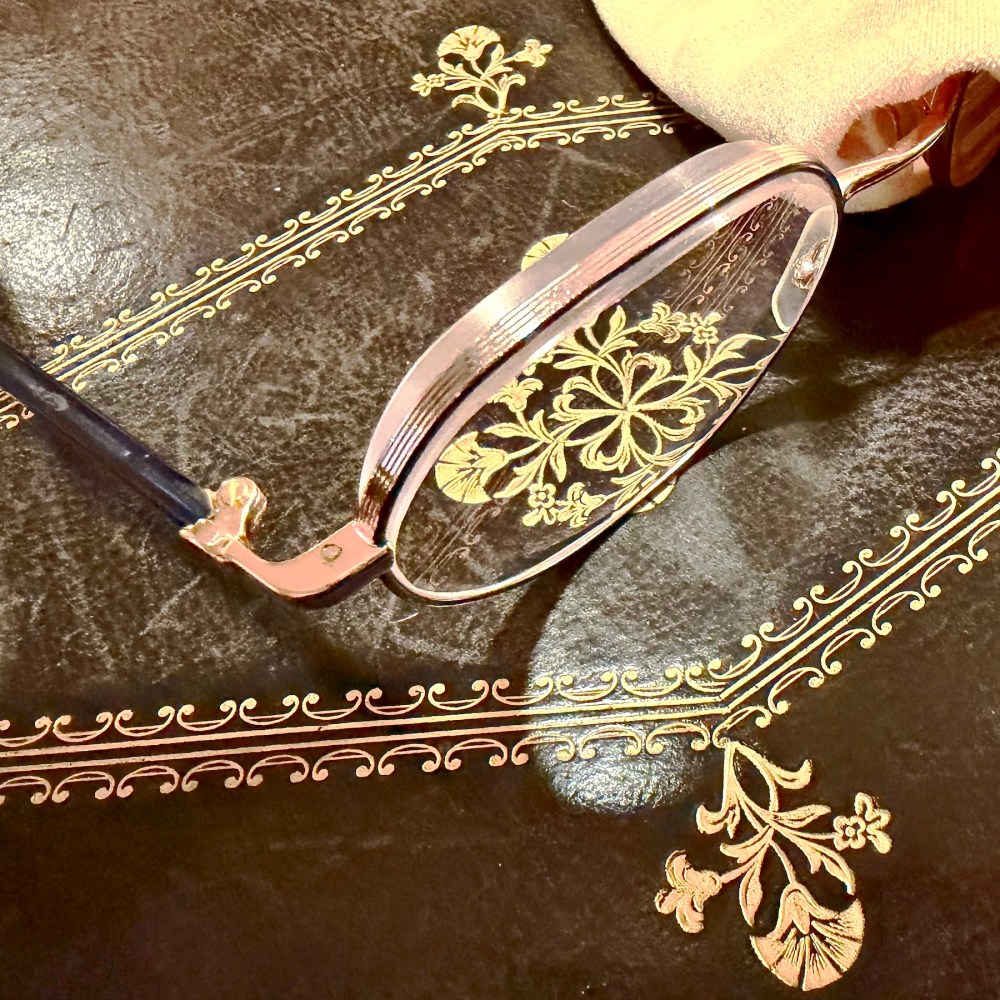
Despite my fear and misgivings, we scheduled the procedure with Dr. Hoang, a surgeon at the Dell Childrens Eye Center. Unfortunately, Dr. Hoang is very busy, and I had to wait more than three months for my surgical appointment.
The surgery took a huge chunk out of my fusional amplitude, reducing it from 18 to 6. My new glasses still have prisms, but they feel so much more normal!

Naturally, I had hoped to correct my diplopia altogether through this surgical intervention, and for a few glorious days right afterwards, that seemed to be a possibility. But by the time all the new visual parameters were evaluated by my aged brain over the following weeks, a small amplitude remained. I am grateful and happy about this improvement, and I hope it will last a while!
To celebrate my “new” vision after we picked up the new prescription glasses, I assembled a tasty Japanese-style feast for us.

MY (Japanese) CUCUMBER SALAD
1 English cucumber, crinkle-cut into discs or half-moons
Diced onion, celery, garlic (optional)
In a lidded jar, combine:
6 Tbs Rice Vinegar, natural (plain, not seasoned)
3 Tbs (light) Soy Sauce
2 Tbs Mirin
1 Tbs Sesame Oil
1 tsp Fish Sauce
Add veg and marinate at room temperature for ~1 hour, turning often.
Refrigerate before serving;
It’ll keep for a couple of weeks in the fridge


Nicely done!
LikeLike